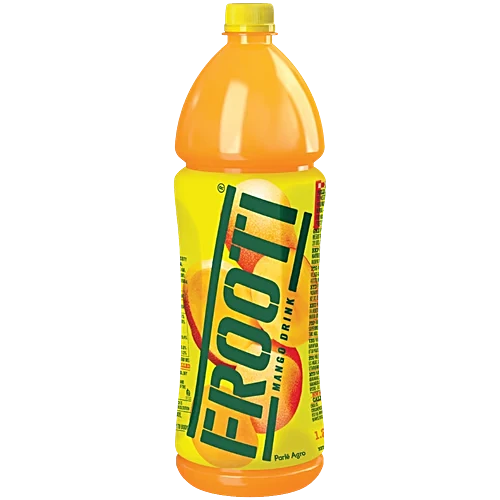
Parle Agro, Frooti
C
ProfileModerate
Frooti Mango Drink
BEVERAGES INVerified
Pack Size
1.2 L
Serving Basis
100 ml
Barcode
8902579103187
Frooti is a thermally processed ready-to-serve mango fruit drink made from water, sugar and 11.2% mango pulp, with a mango flavouring and additive system. It is sold chilled and consumed directly as a sweet mango-flavoured beverage. This pack is a 1.2 L PET bottle.
Data last verified: 23 Jul 2026
Processing level
NOVA 4Ultra-processed
NOVA food-processing classification (Monteiro et al.), derived from the ingredient list. How this works
Nutritional Level Analysis (per 100g)
Fat
low
Sugars
moderate
Salt
low
Levels use standard FSA/WHO per-100g thresholds applied to the label's declared values. See the thresholds
Nutritional Transparency Profile
"Frooti Mango Drink is a thermally processed ready-to-serve mango beverage classified as ultra-processed (NOVA 4). Per 100 ml it supplies 62.9 kcal almost entirely from carbohydrate (15.7 g), of which 14.2 g is added sugar and only 1.4 g is naturally occurring fruit sugar, with no protein or fat. Mango pulp makes up 11.2% of the formulation; the remainder is water, sugar and an additive system of acidity regulators, stabilizers, a preservative, an antioxidant, a synthetic colour and an antifoaming agent. It is a high added-sugar-density beverage with a synthetic colour (INS 110)."
Nutritional Highlights
- • Fat-free and contains 11.2% mango pulp
- • Ascorbic acid (INS 300) is present as a vitamin C antioxidant
- • Clear per-serve and %RDA declaration supports portion awareness
Points of Consideration
- • Very high added-sugar density (14.2 g per 100 ml, about 28.4% RDA per 100 ml serve)
- • Negligible protein, fiber or satiety value from the beverage
- • Contains a synthetic azo colour (Sunset Yellow FCF, INS 110)
- • Ultra-processed formulation with a preservative, stabilizers and multiple additives
- • A full 300 ml glass contributes roughly 42 g of added sugar
Long-Term Pattern Considerations
Published research associates frequent long-term consumption of sugar-sweetened beverages high in added sugars with increased risk of weight gain, dental caries and adverse metabolic considerations. WHO recommends limiting free sugars to below 10% of daily energy intake, a threshold a modest volume of this drink can approach on its own.
Scientific Evidence Sources
WHO Guidelines
FSSAI Standards
NIH Clinical Research
*AI-synthesized from the product's declared ingredient list and public regulatory information. Confidence varies with how complete the label data is.
Ingredient Interaction Index
As a liquid-calorie beverage, the added sugars are rapidly absorbed and provide low satiety per calorie compared with whole fruit, which retains fiber. The formulation contains both sodium benzoate (INS 211) and ascorbic acid (INS 300); published research and US FDA testing have documented that beverages containing this combination can form low levels of benzene under heat and light exposure, and IARC classifies benzene as a Group 1 agent — reputable manufacturers control this through formulation and storage. The citric acid and citrate buffer maintain an acidic pH that supports both flavour and preservative efficacy.
Legal Context: This analysis is generated by indexing publicly available nutritional data and published research. It does not constitute medical advice, diagnosis, or clinical recommendations. Always consult a qualified healthcare professional.
AI-Generated Research SynthesisThis analysis was synthesized by BetterBite AI using peer-reviewed literature.AI can make mistakes or misinterpret scientific context.This information is for transparency assistance only. Always cross-reference with primary sources and consult a healthcare professional for clinical decisions.
C
TRANSPARENCY PROFILE
Moderate
Some processing or additives present
Detailed Review Recommended
Profile Spectrum — Nutritional Index
A
B
CACTIVE
D
E
← Nutrient DenseMost Processed →
5.0/10
Health Score
Moderate
Concern Index
Calculation Pillars:
How we calculate this →Processing Level
Additive Density
Added Sugar
Sodium
Saturated Fat
Smart Suggestions to Eat
Personalized consumption insights
- 1Treat as an occasional beverage rather than a routine daily drink
- 2Prefer whole mango or unsweetened mango pulp for fiber and lower free-sugar intake
- 3Consider diluting or choosing a smaller serving to reduce added-sugar load
- 4Store away from heat and direct light, as recommended for benzoate-containing drinks
Clinical Context: AI-synthesized research patterns based on ingredient synergy. Not a medical prescription. Consult a professional before significant dietary changes.
Smart Swap Ideas
AI-suggested snack types to explore — not specific products
Fresh mango or homemade mango smoothie without added sugar
Unsweetened diluted 100% fruit juice in small portions
Plain or lightly flavoured water for routine hydration
Unsweetened buttermilk (chaas) as a traditional cooling drink
Nutrition Facts (per 100g)
Carbohydrates15.7g
Sugar15.6g
Protein0g
Total Fat0g
Sodium25mg
Nutritional values sourced from Open Food Facts and product labels. Actual values may vary.
Ingredient Transparency
Tap any row · FSSAI, FDA, EFSA
12 ingredients1
Sugar
0Moderate
Sweetener / flavour balancing
2
Flavouring Substances
0Synthetic
LowFlavouring
3
Citric Acid
0INS 330
No NotablesAcidity regulator
4
Water
No Notables
Solvent / base medium
5
Mango Pulp
11.2%No Notables
Fruit component / flavour base
6
Trisodium Citrate
INS 331(III)
No NotablesAcidity regulator / buffer
7
Sodium Carboxymethyl Cellulose
INS 466
LowStabilizer / thickener
8
Xanthan Gum
INS 415
No NotablesStabilizer / thickener
9
Sodium Benzoate
INS 211
ModeratePreservative
10
Ascorbic Acid
INS 300
No NotablesAntioxidant
11
Sunset Yellow Fcf
INS 110
ModerateFood colour
12
Polydimethylsiloxane
INS 900A
LowAntifoaming agent
| Ingredient | Concern | Function | Notes |
|---|---|---|---|
1 Sugar0 | ⚠Moderate Concern | Sweetener / flavour balancing | Free sugars are recommended by WHO to stay below 10% of daily energy, though this product's contribution is small. |
2 Flavouring Substances0 Synthetic | ✓Low Concern | Flavouring | Flavouring substances are used at very low levels under permitted-list regulation, with identities not individually disclosed on the label. |
3 Citric Acid0 INS 330 | ✓No Notable Concerns | Acidity regulator | A well-characterized food acid with a long history of use and no numerical intake limit assigned by JECFA. |
4 Water | ✓No Notable Concerns | Solvent / base medium | Potable water is the base of the beverage and carries no specific concern. |
5 Mango Pulp11.2% | ✓No Notable Concerns | Fruit component / flavour base | A conventional fruit ingredient contributing the drink's mango character at 11.2% inclusion. |
6 Trisodium Citrate INS 331(III) | ✓No Notable Concerns | Acidity regulator / buffer | A common buffering salt regarded as safe at food-use levels, with no numerical intake limit assigned. |
7 Sodium Carboxymethyl Cellulose INS 466 | ✓Low Concern | Stabilizer / thickener | A permitted cellulose-based thickener regarded as safe at food-use levels, with emerging research on emulsifiers still being evaluated. |
8 Xanthan Gum INS 415 | ✓No Notable Concerns | Stabilizer / thickener | A fermentation-derived hydrocolloid regarded as safe, with no numerical intake limit assigned. |
9 Sodium Benzoate INS 211 | ⚠Moderate Concern | Preservative | A permitted preservative within an established acceptable daily intake; in the presence of ascorbic acid, storage conditions are relevant to benzene formation. |
10 Ascorbic Acid INS 300 | ✓No Notable Concerns | Antioxidant | A widely used antioxidant and essential vitamin regarded as safe at food-use levels. |
11 Sunset Yellow Fcf INS 110 | ⚠Moderate Concern | Food colour | A permitted synthetic colour within an established acceptable daily intake; public sources indicate EU products carry a children's activity-and-attention advisory — verify current status with FSSAI. |
12 Polydimethylsiloxane INS 900A | ✓Low Concern | Antifoaming agent | A permitted silicone antifoaming agent used at very low levels within an established acceptable daily intake. |
Research sourced from FSSAI · FDA · EFSA · WHO · Peer-reviewed literature. Informational only — not medical advice.
More Alternatives
Better-scoring options in this category
Evidence-BasedSee all →
Disclaimer: These alternatives are algorithmically suggested based on nutritional indexing and ingredients. This does not constitute a commercial endorsement, criticism of the current product, or medical advice.
Important Disclaimer
BetterBite provides nutritional transparency insights based on publicly available data from regulatory databases (FSSAI, FDA, EFSA, WHO), published peer-reviewed research, and manufacturer-declared product information. This platform is designed for educational and informational purposes only.
The content displayed on this platform does not constitute medical advice, diagnosis, or treatment recommendations. Transparency scores, nutritional assessments, and ingredient analyses represent algorithmic interpretations of publicly available data and should not be used as a substitute for professional medical or nutritional guidance.
Individual dietary needs, allergies, and health conditions vary significantly. Always consult a qualified healthcare professional, registered dietitian, or physician before making dietary changes based on information found on this platform. Product formulations may change without notice — always verify information against current product labels.
AI Research Disclosure: Technical analysis and research patterns on this page are synthesized using BetterBite AI researchers.AI can make mistakes or provide incomplete insights.This technology aggregates data from scientific literature for informational assistance. Always verify findings against primary sources for critical dietary decisions.
How We Score Products••Data Sources: Open Food Facts • WHO • FSSAI • FDA • EFSA • Published Literature